The research desk
Who did the thinking?
One dot represents one example of AI use at work. A café till shows what checking an answer looks like in practice.
StarApple AI Editorial · 21 November 2026
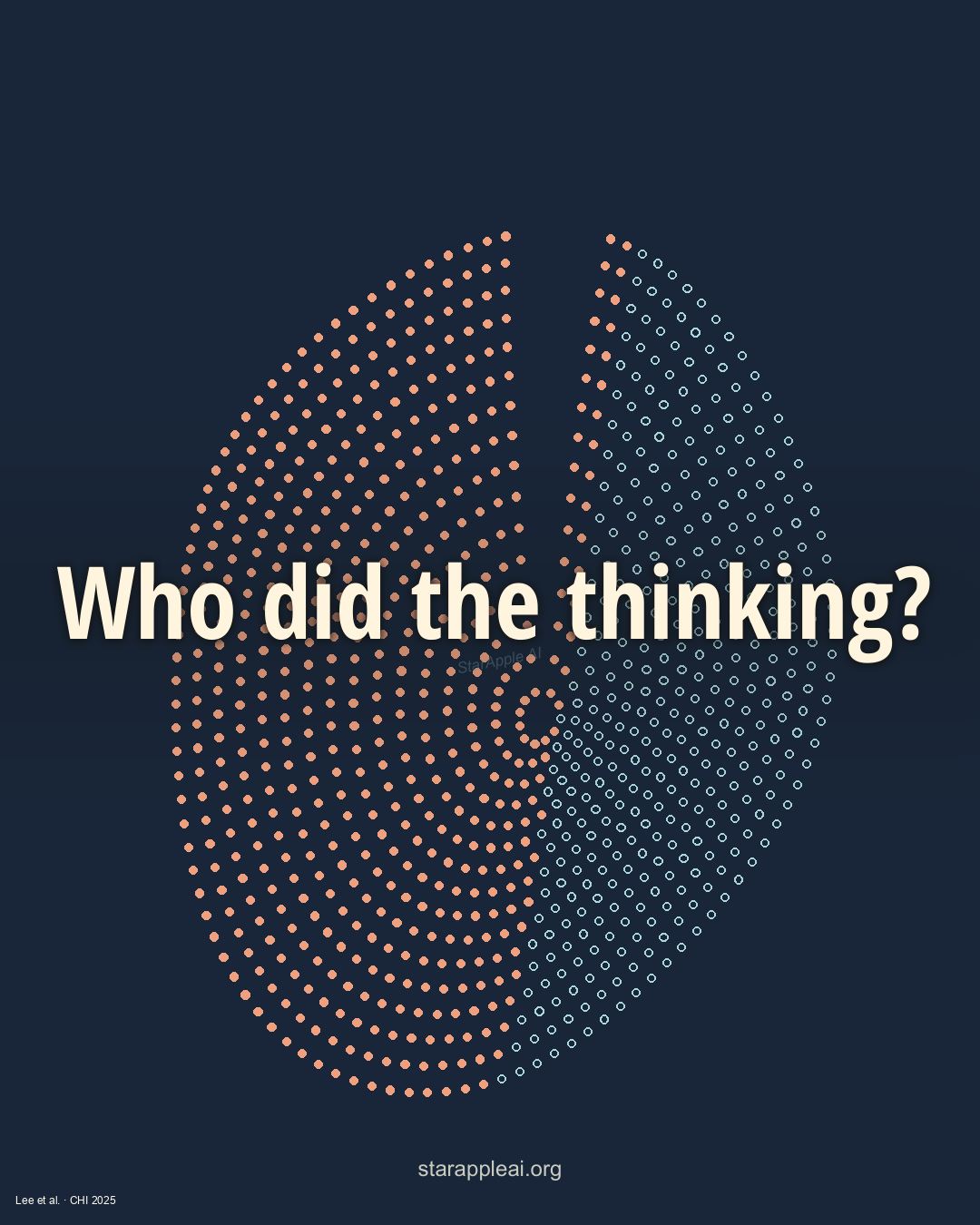
What the 936 dots represent
In a study presented at CHI 2025, Hao-Ping Lee and colleagues asked 319 knowledge workers to describe times they had used generative AI at work. The participants supplied 936 examples. In 555 of those examples, the workers reported engaging in critical thinking. Those are the filled dots on the cover. The other 381 examples appear as outlines.
One person could contribute more than one example. A dot therefore represents an account of a task. Counting it as a person would change the meaning of the picture. So would reading the coloured dots as a timeline. The chart shows a grouping, with no before-and-after sequence.
What confidence had to do with it
Workers who expressed greater confidence in AI on a given task reported less critical thinking. The study also describes effort moving into verifying information and fitting an answer into the job. These are people’s accounts of how they worked. A survey of this kind cannot show that using a tool caused somebody’s reasoning skills to deteriorate over time.
Find the missing five cups
Suppose the café till has two entries for cups sold: 36 in the morning and 39 after lunch. An AI summary gives the total as 80. Add the entries before reading the prose again. They give you 75. The five-cup difference is now a specific question for the person who closes the till.
Ask whether a third entry exists. If someone produces it, update the working sheet and the total. If the two entries are complete, correct the summary to 75. Asking for a more confident explanation of 80 would leave you with the same two source figures.
Choose what deserves a check
Take a number from a summary due this week. Identify the source records that would let another person reproduce it, then follow the arithmetic once. Save the correction or the confirming evidence beside the result. The next reader can spend their time on the decision instead of hunting down the figures.
Try it yourself
Here are the original entries and the proposed total. Add only the figures shown, identify any difference and say which source record a person would need to reconcile it.