Can the plan survive a change?
Check the week’s commitments against your money, time and evidence.
Can your holiday budget survive one surprise?
A budget is easier to judge after a cost changes. Try the sample gathering on these cards. Calculate the original total before asking AI. Then update transport to the new price. The revised plan uses all the available money.
Choose an optional cost to reduce. Show what remains after the change. Keep real bookings and payments under your control. A useful response includes both plans and the reason for the reduction.
Try the prompt
Use this sample J$12,000 budget: food J$7,200, transport J$2,400 and decorations J$1,200. Calculate the total. Calculate the unspent amount. Change transport to J$3,600. Recalculate both results. Suggest one optional reduction that leaves J$600. Do not buy anything.
Read the teaching card text
Now change one thing.
Transport rises to J$3,600. Guests and food stay the same. Calculate the new total. How much money remains for another surprise?
Transport | J$
Original | 2,400
Revised | 3,600
sample increase J$1,200
Show the revision.
The revised total is J$12,000. Nothing remains. Reducing decorations by J$600 restores a J$600 buffer: money left for unexpected costs.
Stage | Total | Spare
Original | 10,800 | 1,200
Revised | 12,000 | 0
Trim decor | 11,400 | 600
sample J$ budget; no purchase

Turn a shared memory into a three-clue game.
A small game can turn a shared memory into a gift. Draw the route on paper first. Choose a starting point. Write three clues. Add a personal ending.
Ask a coding assistant to build that version. Test each wrong answer. Test the restart button. Try the controls on a phone. Use invented names if the story contains private details. Remove unnecessary accounts or data collection before giving the game to someone. Practice example: I have pages. You turn them. I can hold a story. Answer: a book. Replace these with clues tied to your own shared memory.
Try the prompt
Build a three-clue browser game from this non-private outline. Use readable text and original shapes. Add keyboard and touch controls. Add a restart button. Include my ending message. Do not add accounts or external services. Explain how to test each route.
Read the teaching card text
Clue 1 | Clue 2 | Clue 3 | Your message
Original game outline; test every route
Sources and tool guides

A real memory makes the greeting personal.
A greeting can begin with a moment you both remember. Add a wish that fits the person. The worked example pairs morning walks with more time together in January. Use your own event.
If you use AI, ask for a light edit. Check that the draft keeps your meaning. Remove invented feelings or promises. Read the result aloud before sending it. The final message should contain words you would use in a conversation with that person.
Try the prompt
Lightly edit my greeting. Keep the memory I wrote. Keep my intended wish. Do not add events, emotions or promises. Use plain language. Give one version. Explain any change that could alter my meaning.
Read the teaching card text
Part | worked example
Memory | Our morning walks
Wish | More time in January
Use your own true detail
Use this year’s AI errors to improve January.
Old corrections show where a process needs attention. Choose three tasks you completed with an AI tool. Include one that needed repairs. Compare each result with its original source. Record the exact error.
Add a check where someone could have caught it. Test that check on a harmless copy. Keep the review private if it contains company or personal information. An AI Officer manages the team’s AI work. This person can turn repeated errors into tasks for testing the tool.
Try the prompt
Classify these redacted errors by source, calculation, formatting or permission. Propose one specific check for each error. Identify the role that should review a failure. Do not invent events. Mark checks that still need testing.
Read the teaching card text
Final result | Original file | Find mismatch
Use authorised private records
Name the actual error.
Record the specific error. Was a date wrong? Did a row disappear? Did the tool invent a quotation? Keep personal details out of shared examples.
Error | Record
Wrong date | Source date
Missing row | Row identifier
Invented quote | No matching passage
Illustrative error categories
Fix the point where it escaped.
Match each error to a check. Recalculate wrong totals. Match quotations to source passages. Require approval before sending messages.
Error | Check
Wrong total | Recalculate
Invented quote | Match passage
Unapproved send | Permission gate
Examples; checks need testing
Test the new check.
Repeat the task with harmless data. Check whether the new rule catches the error. Record failures. Keep the tested rule beside the next similar task.
Harmless copy | Run new check | Record failure
Suggested test process
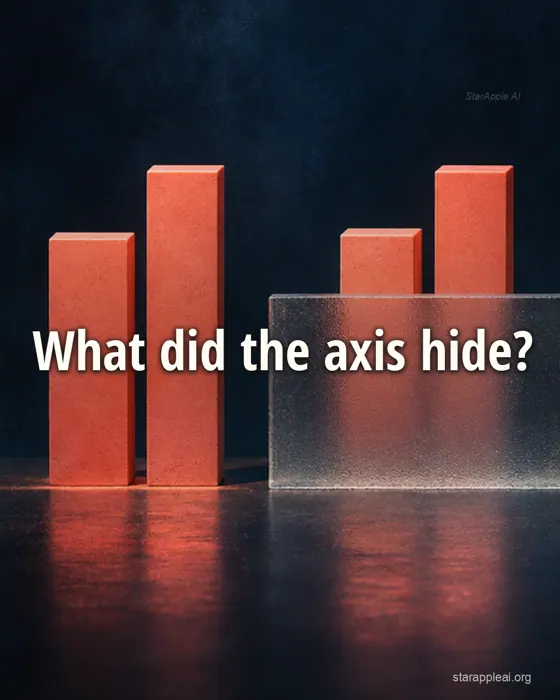
The numbers are right. Is the chart fair?
A chart can use correct numbers and still exaggerate a change. These sample orders rose from fifty to fifty-five. The increase is ten per cent. An axis is the numbered scale beside the chart. When it starts at forty-nine, the visible bars have heights of one and six.
Inspect the axis before judging the picture. A shortened scale can help with some clearly labelled line charts. For this bar comparison, a zero baseline shows the quantities fairly.
Try the prompt
Use sample orders of 50 and 55. Calculate the increase. Express it as a percentage of 50. Explain a bar axis that starts at 49. Redraw the bars from zero. Label the values. Do not invent extra weeks.
Read the teaching card text
Chart B magnifies the visual gap.
Orders rose by 5, or 10% of 50. Starting the bar axis at 49 makes the visible heights 1 and 6. Use a zero baseline for this bar comparison.
55 − 50 = 5 | 5 ÷ 50 = 10%
Chart B visible heights 1 and 6; use zero baseline
Which AI tool did you actually use?
A subscription review starts with your records. Check what you paid. List the tasks you completed with each tool. Include the time needed to repair its output.
Ask AI to organise the comparison. Check current prices and renewal dates in the account. Two tools may duplicate a feature, but one could perform a task you need. Leave missing usage data blank. Keep cancellation decisions with the account owner. A feature list alone cannot tell you how much time you saved.
Try the prompt
Organise my non-sensitive subscription notes. Include cost, renewal date, completed tasks, repair time and essential features. Mark missing evidence. List questions to answer before deciding. Do not estimate savings. Do not cancel accounts or change plans.
Read the teaching card text
Evidence | Your record
Paid cost | Check receipt
Tasks used | Check history
Repairs | Check time log
Blank review aid; no savings assumed
Your plan has fifteen hours. You have twelve.
A January plan needs to fit the hours you have. Put existing commitments on the calendar first. Use a similar completed task to estimate new work. Include time for another person’s review.
Set an internal draft date before the real deadline. In this sample week, planned work exceeds available time by three hours. Decide what moves before the week starts. Ask AI to identify the conflict. Keep decisions about commitments under your control.
Try the prompt
Draft a weekly plan from these commitments and estimates. Show available hours. Show planned hours. Keep review time visible. Include a buffer for delays. Flag work that does not fit. Suggest choices without moving appointments or promising deadlines.
Read the teaching card text
Booked hours | Free hours | New work
sample planning example. Check your actual calendar.
Estimate from a previous task.
Use a similar completed task to estimate new work. Add time for review. Mark estimates so you can revise them when information changes.
Draft session | Second session | Review session
Illustrative three-session report estimate
Keep an internal deadline visible.
Set an internal draft date before the real deadline. Name the person whose reply you need. Decide when to ask them.
Ask for input | Internal draft | Real deadline
Choose dates from the actual commitment
Check capacity before saying yes.
sample week: 12 free hours and 15 hours of planned work. Move, shorten or decline at least 3 hours. The plan must fit the available time.
Week | Hours
Available | 12
Planned | 15
Must move | At least 3
sample capacity example